Nusa Penida weather follows Bali's tropical seasonal pattern: a drier season, usually through the middle of the year, and a wetter, monsoon-influenced season around the turn of the year. Exact timing shifts every year. Indonesia's meteorological agency, BMKG, treats Nusa Penida as its own seasonal zone. In 2026 it forecast the dry season to begin there in early March, earlier than most of Bali.
For trip planning, three things matter more than any single month: the season you are traveling in, the sea conditions on the day you cross from Bali, and the local forecast on the morning of each outdoor activity. This guide covers all three.
Short answer: For most travelers, the drier months, roughly May to September in a typical year, are the easiest time to visit Nusa Penida for sightseeing, beaches and boat trips. Timing varies each year, and sea conditions can change in any season. Wetter months can still work with flexible plans. Check BMKG forecasts before you travel.
Nusa Penida is part of Klungkung Regency in Bali Province, southeast of mainland Bali across the Badung Strait. Like the rest of Bali, it is warm all year, and the main seasonal difference is rainfall rather than temperature.
BMKG's Bali Climatology Station divides Bali into 20 seasonal zones (Zona Musim, or ZOM), and Nusa Penida has its own zone. That matters because Nusa Penida doesn't always follow central Bali's timing. For 2026, BMKG forecast the dry season to start on Nusa Penida in the first ten days of March, ahead of the rest of Bali. It also flagged Nusa Penida among the areas at risk of extreme drought because of El Niño.
For the 2026/27 wet season, BMKG forecast a later-than-normal start across Bali: late November in a few zones and December in most. It expected the peak for most of Bali in February 2027. It also forecast a shorter rainy season in eastern Bali through to Nusa Penida than in central Bali.
Daily weather still varies. A dry-season day can bring cloud or a passing shower, and a wet-season day can be bright between storms. Treat seasons as probabilities, not promises.
The best time depends on what you plan to do. These recommendations follow the general seasonal pattern above; none of them guarantee conditions.
The drier months generally give the best odds for the island's clifftop viewpoints and longer road trips, with clearer skies and drier roads. Some roads on Nusa Penida are steep and narrow, so lower rainfall makes driving and walking easier. See our guide to things to do in Nusa Penida for where to go.
Beach days benefit from drier, calmer weather, but surf and access at each beach depend on swell, tide and the path down, not just rain. Our guide to the best beaches in Nusa Penida covers individual beaches.
Snorkeling and diving depend on the day's currents, swell, tides and site conditions as much as the season. There is no single "safe" month. Book with an operator who checks conditions each day, and see the snorkeling section below.
Crowds depend largely on holiday periods in Indonesia and in visitors' home countries, not only on weather. Shoulder months around the start and end of the dry season can offer a balance, but there is no official crowd calendar to plan around.
Dry season dates: In a typical year, Nusa Penida's drier season runs roughly from April or May to October, but the timing changes from year to year. In 2026, BMKG forecast it to begin on Nusa Penida in early March and expected the dry-season peak across Bali in August.
Advantages: better odds of clear viewpoints, drier roads and easier boat days.
Downsides: stronger sun exposure and dry, dusty conditions, especially in drought years such as 2026. The drier season also tends to coincide with busier travel periods.
Sea conditions: a drier sky doesn't mean a calm sea. BMKG has issued high-wave warnings for the Badung Strait, the crossing between Sanur and Nusa Penida, during dry-season months such as July.
Rainy season dates: In a typical year, Nusa Penida's wetter season runs roughly from November or December to March, often with the heaviest rain from January to February. For 2026/27, BMKG forecast a late start in late November to December 2026 and a peak in February 2027 for most of Bali.
What it means for travel: trips are still possible, but plan for heavier showers, wet and slippery roads and trails, and more days when outdoor plans need to move.
Ferry awareness: BMKG regularly issues wave warnings for waters around Bali, including the Badung Strait, in the wet season as well. Check marine forecasts before each crossing.
Upside: vegetation is usually greener after rain begins, and many travelers find the island quieter outside the main holiday periods.
| Factor | Drier season (roughly Apr/May–Oct) | Wetter season (roughly Nov/Dec–Mar) |
|---|---|---|
| Rain | Less frequent; showers still possible | More frequent and heavier at times; peak usually Jan–Feb |
| Sightseeing | Better odds of clear viewpoints and dry roads | Plan around showers; roads and trails can be slippery |
| Beaches | Generally easier, but swell and tide still matter | Possible on fine days; check conditions and paths |
| Snorkeling | Depends on daily currents and swell, not the season alone | Same; rain can also affect visibility near shore |
| Sea crossings | Wave warnings still occur (e.g. July) | Wave warnings also occur; allow schedule flexibility |
| Crowds | Often busier, depending on holiday periods | Often quieter outside holiday periods |
| What to pack | Sun protection, water, breathable clothing | Light rain jacket, dry bag, grippy footwear |
| Flexibility needed | Moderate | High: build in a buffer day |
Broad seasonal guide based on BMKG's seasonal outlooks for Bali and Nusa Penida. It shows typical tendencies, not rainfall measurements, and the timing of each season shifts from year to year.
| Month | General pattern | Rain consideration | Good for | What to watch |
|---|---|---|---|---|
| January | Wetter season | Often among the wettest months | Flexible, unhurried stays | Heavy showers; wave warnings |
| February | Wetter season | BMKG forecast Bali's 2027 peak here | Indoor and relaxed plans | Heavy rain; sea conditions |
| March | Transition | Mixed; dry season began early on Nusa Penida in 2026 | Shoulder-season travel | Changeable days |
| April | Transition to drier | Decreasing in most years | Sightseeing with some flexibility | Late showers |
| May | Drier season | Generally lower | Viewpoints, beaches, boat trips | Sun exposure |
| June | Drier season | Generally lower | Viewpoints, beaches, boat trips | Swell on some days |
| July | Drier season | Generally lower | Viewpoints, beaches, boat trips | Past Badung Strait wave warnings |
| August | Drier season | BMKG forecast Bali's 2026 dry peak here | Viewpoints, beaches | Heat, dust, busier periods |
| September | Drier season | Generally lower | Viewpoints, beaches, boat trips | Sun exposure |
| October | Drier, nearing transition | Usually low but can increase | Shoulder-season travel | Early showers in some years |
| November | Transition to wetter | Onset late Nov–Dec in 2026 | Flexible travel | Changeable days |
| December | Wetter season | Rain more frequent | Flexible, unhurried stays | Heavy showers; sea conditions |
Short answer: Yes. Fast boats between Bali and Nusa Penida cross the Badung Strait, where BMKG issues high-wave warnings in both seasons. Sanur port authorities have delayed speedboat departures during extreme weather. Check BMKG marine forecasts and confirm with your operator on the day.
Don't assume a sunny morning means a smooth crossing; wind and swell drive sea conditions. Build some flexibility into your return day, especially if you have an onward flight. For boat logistics, see our Sanur to Nusa Penida ferry guide. For where you'll land, see our Nusa Penida harbour guide.
Calm, clear days with moderate swell are generally best for snorkeling, but weather is only part of the picture. Nusa Penida's waters are a Marine Protected Area where currents can be strong, and conditions vary between sites and from hour to hour. Snorkel with an experienced local operator who checks currents and tides daily, and follow their call if they change sites or cancel. Our Nusa Penida snorkeling guide covers sites and practical tips.
Yes, for some activities. Tides affect water depth over reefs, entry and exit points for snorkeling, and how much beach is exposed. Tides are a separate thing from weather: a sunny day can still have a high tide or a strong tidal current.
Don't rely on a static tide table. Check current predictions for the date you are visiting, for example from Indonesia's Geospatial Information Agency (BIG) tide prediction service at srgi.big.go.id/tides, and ask your boat or snorkel operator how the tide will affect your plans.
Drier months generally give better odds of a clear sunset, but cloud cover changes daily in every season. Sunset time also shifts during the year, so check the exact time for your date with a reliable astronomical calculator rather than relying on a fixed time.
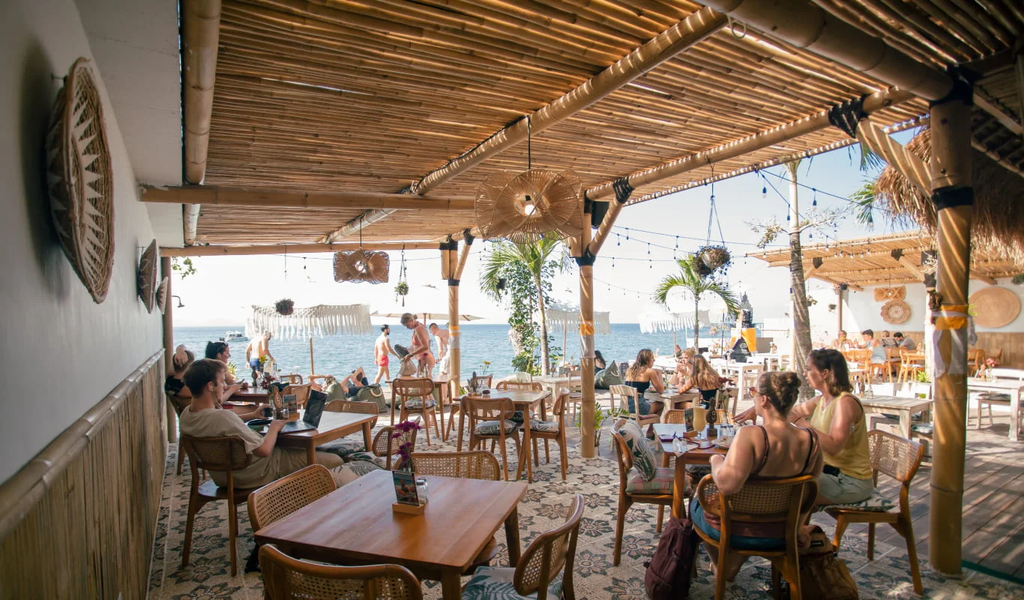
If you're spending the evening in Ped, on Nusa Penida's north coast, Penida Colada's beachfront deck runs a Sunset Happy Hour from 4pm to 6pm every day, which makes an easy base for watching the light change over the water.
Short answer: Check BMKG's Bali forecast at bbmkg3.bmkg.go.id or the InfoBMKG app. Check BMKG's marine forecast at maritim.bmkg.go.id before any boat trip. Confirm departures with your ferry operator. Check again on the morning you travel, and keep outdoor plans flexible.
If you have a slow morning while waiting for the weather to clear, a beachfront breakfast in Ped is an easy way to start the day.
There is no guaranteed best month. In a typical year, May to September falls within the drier season, which suits sightseeing and boat trips. Timing varies by year, so check BMKG's seasonal outlook for your travel year.
Usually from about November or December to March, with the heaviest rain often in January and February. For 2026/27, BMKG forecast a late start (late November to December 2026) and a peak in February 2027 for most of Bali.
It can be, if your plans are flexible. Expect heavier showers, wet roads and occasional rough seas, and schedule outdoor activities for the clearest part of the day.
December usually falls in the early wetter season, so rain is more frequent than in mid-year. In 2026, BMKG expected most of Bali's rainy season to begin in December.
July usually falls in the drier season. Rain is generally less frequent, but sea conditions can still be rough, and BMKG has issued Badung Strait wave warnings in past Julys.
Yes. Departures can be delayed or cancelled when wind and waves are high. Check BMKG marine forecasts and confirm with your operator on the day.
Yes, especially for snorkeling and beach access. Use a current tide prediction, such as BIG's service, and follow local operator guidance.
Whatever the season, Penida Colada in Ped serves brunch from 8am and mains until 10pm, so it fits around early-morning viewpoints or an afternoon return from the beach. See the menu, book a table or get directions.
Weather information last verified November 12, 2026. This guide describes general seasonal patterns. It is not a forecast, so always check BMKG for current conditions.